For more details:

Need a strategy to develop business in Brazil? Info@SIS4Biz.com

Over 1.2 million Brazilians visited the United States in 2010, US is main destination of Brazilian exports...


A $6 billion of contribution to US economy in 2010 and projected to double by 2016, when US could host a record of 2.8 million Brazilians.
Florida continues to be the number one US destination for Brazilians, no wonder Brazil was named the “Floridian” of the year by Florida Trend magazine in January 2012.
Brazilians are coming to Florida for tourism and for business, expanding existing businesses and investments.
So far this year, the United States has been the main destination of Brazilian exports, US$ 4.6 billion; Brazil started 2012 with a record monthly current account deficit of US$ 7.086 billion. That is more than the Central Bank forecast of US$ 6.7 billion, and well above the January 2011 deficit of US$ 5.584 billion. Foreign direct investment, at US$ 5.433 billion, was not sufficient to cover the deficits.

CNN article: Florida's tourism gets a boost from a Brazilian invasion

By John Couwels:


Florida is the top U.S. vacation destination for Brazilians, who are taking advantage of a favorable exchange rate and low prices. Brazilians outnumbered all other international travelers to Florida in 2011, up 41% from the previous year, according to state tourism officials.
And there's no sign of this Brazilian invasion slowing down: The U.S. Commerce Department projects 1.5 million Brazilians will visit the United States in 2012 -- and most of them will head to Florida. Floridians are used to seeing Brazilian tour groups marching through outlet malls and theme parks, usually dressed in matching T-shirts in single-file lines behind their leader. These Brazilian tourists are usually loaded with cash and ready to clear the shelves of the name-brand outlets. That's because even at regular price, many goods and services in the United States are much cheaper than in Brazil, where tariffs, taxes and transportation costs can mean higher prices.

"We [took] about 15,000 passengers on shopping tours, and they on average spend about $300 to $400 each person," said Claudia Menezes, vice president of Pegasus Transportation. And those were just the Brazilian tour groups visiting outlet malls and theme parks in South Florida and Orlando.
Menezes says she expects her business to double in 2012. That could be a conservative estimate as the United States plans to expand its global entry program, which aims to speed up the visa approval process for international visitors.
President Obama announced the expansion of the plan last week at a news conference at Disney World in Orlando, Florida. He said he hopes to make it easier for visitors from countries "with rapidly growing economies, huge populations and emerging middle classes" like Brazil and China to visit the United States. He said he wants the plan expanded "this year."
He said Brazil was "especially important for Florida" because it has "a huge population that loves to come to Florida ... but we make it too hard for them."
"We want them spending money here, in Orlando, in Florida in the United States of America, which will boost our businesses and our economy," he said.
It's a long process for many Brazilians to get to the United States: On average, people have to wait 76 days just to get an interview at the largest U.S. consulate in Brazil, in Sao Paolo. And with only four U.S. consular offices in a country that is bigger than the continental United States, a lot of Brazilians trying to visit the U.S. must travel long distances for their interview. As a result, many are opting to travel to Europe because the visa process is easier.
Menezes says her tour business depends on the United States improving its visa process:
"If they make it easier, it would be even more people coming here," she said.
On a recent afternoon at the Orlando Premium Outlets near Disney World, one of the hottest-selling items among the Brazilian tourists is luggage. They buy the suitcases, then stuff them with recently purchased shoes, clothing, bags and electronics until the luggage is almost bursting at the seams.
That kind of spending has translated into billions of dollars in revenue for the United States. In 2010, Brazilian visitors spent nearly $6 billion on U.S. travel and tourism-related goods and services, nearly 30% more than the prior year, according to a report from the U.S. Commerce Department.It's a trend that has been going on since 2003 and has, according to the report, "propelled Brazil up the rankings to become the fifth largest international market for U.S. travel and tourism-related exports."
Florida's retailers aren't the only ones getting an economic boost: Many of Central Florida's numerous theme parks have also seen a large increase in Brazilian tourists. Disney World says 2011 was a record-breaking year for Brazilian guests at its parks.
As a result, Disney hired 54 Portuguese-speaking "Super Greeters," most of them from Brazil, to assist Brazilian tour groups throughout Disney's parks.
SeaWorld Orlando has seen a steady increase in guests from Brazil over the past five years, says Peter Frey, senior marketing officer with SeaWorld Parks.
As a result, SeaWorld recently launched a website in Portuguese, and Frey says the company is looking to expand its Portuguese-speaking employees.
"We are offering classes for employees to learn the basics of Portuguese," he said.
Brazil's economy is booming after a quick recovery from the global economic downturn, and a new class of Brazilians is traveling and spending money, giving Florida a much-needed economic shot in the arm, according to Sean Snaith, an economics expert at the University of Central Florida.
"There is an emerging middle class [in Brazil] who has disposable income," he said.
Only a few years ago, Brazilian tourists were not always welcomed by shop owners in Central and South Florida, a tour guide said. Today, businesses are catering to these cash-laden Brazilian tourists.
Brazilians are also investing in Florida's sagging real estate market, particularly in South Florida, either for a vacation home or just as an investment. The prices in Miami are a bargain, compared with the prices in Brazil, according to Miami Realtor Cristiano Piquet.
"In Brazil or Rio, high-end real estate is around $1,000 per square foot, while in Miami, you can find high-end oceanfront property, like the Trump Towers, for only $500 per square foot," said Piquet, who gets 80% of his business from Brazilians. He has 75 agents.
"Brazilians love Miami, the weather is similar to Brazil, [it's] very safe ... [and there are] daily flights from Brazil to Miami," he said.
Diego Gasques from Rio de Janeiro, who owns two condominiums in Miami, agrees.
"It's kind of a vacation place for us," he said. "Of course Miami is a beautiful place, a lot of nice people around -- a lot of bodies ... it's a nice place to hang out to have some fun."
While Spanish is still the most popular second language in most South Florida businesses, these days it's becoming more common to hear, "Obrigada e volte sempre!" -- Portuguese for " Thank you, come again!"

Brazilians will benefit with a less severe policy for visas


According to an official release, the US Department of State is committed to improving the visa process, decreasing interview wait times in Brazil and increasing the number of visas issued.
The release pointed out that the initiatives in place would help opening the door to new jobs, exports and more international visitors, which means more revenue for cities and states.
Brazilians already spend billions of dollars in the United States and by making it easier to get a visa will help visitors to return, stay in US hotels, eat in US restaurants, buy American products and develop more business with US companies.

Feliz 2012 - Happy New Year!!

We are exactly where we imagined we would be... So for 2012 let's imagine bigger and better things for ourselves and those around us!! 
HAPPY NEW YEAR!! 

Have a Very MERRY Christmas...

Unless we make Christmas an occasion to share our blessings, all the snow in the world won’t make it ‘white’ and Knowing and working with you has been a blessing in my life and therefore, my family as well.. Thank you!
May we remember Jesus’ birth, the most significant event in all history, and follow his teachings by doing a little more, with love, to someone, not only during this holiday season but during the season we live in this world.

Gov. Rick Scott and delegation visiting São Paulo a city comprising of 19 million inhabitants


Here are some highlights about the city/state:
São Paulo
§  Over 10,000,000 Vehicles in Greater São Paulo
§  It has the largest fleet of helicopters in the world.
§  Urban area: 1,968 km² (760 mi²)
§  3rd in the world in number of high-rise buildings with 5,644, according to Empori's database.
§  According to Mystery Shopping International, the ninth most luxurious street in the world is located in the city, the Oscar Freire Street.
§  Has the largest hospital complex in Latin America, the Hospital das Clínicas of the University of São Paulo with 352,000 m2 (3,788,896.47 sq ft).
§  São Paulo is the 6th city with most billionaires in the world, drawn with Mumbai with 21 billionaires.

São Paulo is the 10th richest city in the world, the biggest financial center in Brazil and is expected to be the 6th richest in 2025.  According to PricewaterhouseCoopers annual economic growth of the city is 4.2%. The city is also unique among Brazilian cities for its large number of foreign corporations. Many analysts point to São Paulo as an important global city, even though this categorization can be criticized considering its serious problems of social exclusion and spatial segregation. Despite being the most important financial center of the country, São Paulo also presents a high degree of informality in its economy.
In recent survey among the 30 to 60 years professionals, (8.163 million), the age bracket that better defines professional lives in Brazil, 46% have come from other areas of the country or from abroad. Among Brazilians, the group with the highest education level is comprised of migrants from the Southeast, South and Midwest regions of the country.
Agriculture within the state of SP present significant growth as well, preliminary figures from the Agricultural Economics Institute of São Paulo State Agriculture and Supply Secretariat shows that the value of agricultural and forestry production in the state reached R$ 61.45 billion (US$ 33.6 billion) this year, growth of 17.1% over last year.


Some of Brazil's Consumers Future Tendencies..

Brazilians over 60 population has grown about 50% in the past 10 years and is projected that by 2020 the population 60+ will be 30 million.
Health awareness and quality of life is also increasing. In comparison, US had 1,300 SPAs in the early 90'  and presently there are over 10,000. In Brazil SPAs were practically unknown 20 years ago and now there are over 1,000, still plenty of growth opportunities.

According to the FGV report, currently 105 million Brazilians belong to the middle class C with a family income in the range of US$ 750 to US$ 3.229 per month, 39.5 million Brazilians became part of the middle class between 2003 and May 2011. (see image with % of population and consumption by location). On recent study showed that while 76% of A, B class opt to shop in supermarkets, 34% of C class and 49% of D and E class opt to alternative purchasing channels where smaller retailers reap the benefit.
These are just some of the new tendencies and how Brazil consumers are changing. Obviously Brazil offers a vast  options of opportunities to companies in general.

BRAZIL FLORIDA ALLIANCE - join us!!

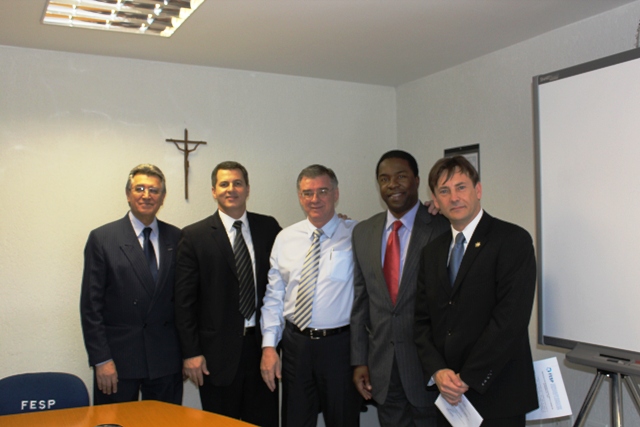
Governor Rick Scott and JAX Mayor, Alvin Brown are visiting Brazil in October...

Opportunities are like the wind, constantly blowing but unless planning and work has been done to capture it and turn it into energy is just wind, meaningless unless you're the energy receiver or the capitalist on the project.. Brazil Florida Alliance can be a good starting point for Brazil opportunities, go ahead and register for our October Meeting ASAP.. http://www.eventbrite.com/event/2287584226/eivtefrnd


Brazil Florida Alliance (BFA) report

October 19th 2011 Meeting Announcement


Nissan Motor planning to invest $1.5 billion to build a factory in Brazil

A Nissan representative in Brazil confirmed plans for a factory in the country producing around 200,000 vehicles annually.

Brazil's government said this month it was raising taxes on imported autos to encourage greater investment in the country's car industry. The national automakers' association Anfavea sees the measure spurring investments, currently estimated at $19 billion in the five years through 2015.
Brazil is a key growth market for the world's biggest automakers, including Italy's Fiat SpA, Germany's Volkswagen AG and U.S.-based General Motors Co and Ford Motor Co.
Nissan and other Asian automakers still lag those big four producers in Latin America's largest economy, but are increasing their presence, including planned factories for Chinese brands Chery and JAC Motors.
A new factory would allow Nissan to ramp up growth in the world's fourth-largest auto market, where it currently shares a plant in Parana with French partner Renault SA.
Nissan sold nearly 37,000 cars and light trucks in Brazil through August this year, compared with nearly 20,000 in the first eight months of 2010, making it the country's No. 12 carmaker by sales, according to dealer association Fenabrave.

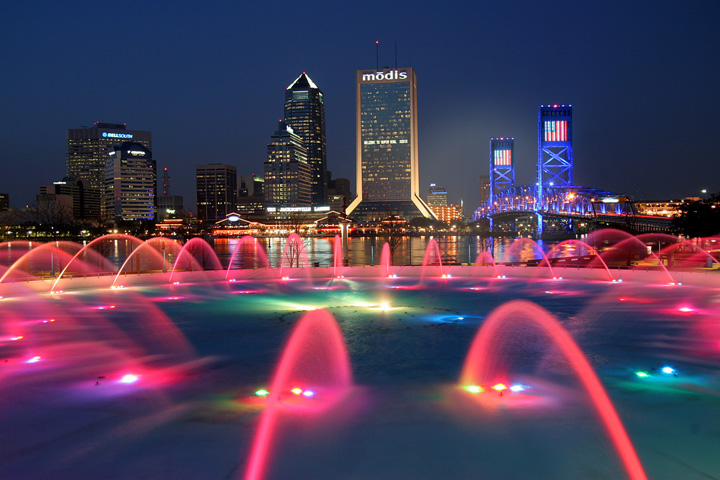
Here's my idea for downtown Jacksonville development... Care to share yours?


Brazilians spent 10 billion dollars overseas in 2010, just in credit card, a 54% increase from previous year. For years now, Brazilians have been flying to Miami and Orlando, sometime over a weekend just to go shopping. In fact, after TAM airlines started their direct service from Brazil to Orlando the malls in the city of Orlando saw a double digit increase during the first quarter of 2011. My suggestion would be to provide a plan with incentives and turn downtown into an attractive shopping area linked to themes of different countries that already connect via JAXPORT, a combination of niche products, brand names and general consumer goods for tourists and local residents wanting to experience different cultures without leaving Jacksonville. Selecting areas around downtown and converting into a free trade for products purchased there and combining with the attractive attraction of a multi-cultural visual experience with stores, restaurants, etc. would bring locals and tourists to the downtown area.

What's your opinion? 


One In Every Three Cars In Brazil Will Be Imported

According to the National Association of Vehicle Manufacturers (Anfavea), the car imports this year will be the largest in the history of the Brazilian automotive industry, the share of imported cars which was 5% in 2005 should reach 23% this year.  This index, however, is considered conservative by analysts, who indicate that models made ​​in other countries account for almost one third of the market, the equivalent of one million vehicles - more than the production of Volkswagen, the largest manufacturer in the industry, which was 826 000 units in 2010.
In 2010, the country imported 660,000 vehicles (18.8% of sales).  In the first half, 390,000 vehicles were imported, 38% more than in 2010. Of this total, only 90,300 were brought in by importers without local factories. 

** (JR comments) 
Opportunities are abundant not only for exporting vehicles to Brazil but also to export certain parts and accessories for this growing number of imports and there's no better place than Florida for the quick and efficient logistics and deliveries required for competitiveness.

Ocean Carriers - Financial reports and list of who's in Brazil

A.P. Møller-Mærsk B shares are adding 7.1 percent in Copenhagen. Report follows several negative financial reports from carriers. APL, Hanjin Shipping and Hapag-Lloyd all reported losses in the first quarter, and Maersk Line parent A.P. Moller-Maersk warned in reporting stronger first-quarter earnings that it expects a slimmer profit later in the year.


Hamburg-Sud, and its Brazilian sister carrier, Alianca, also benefited from a "moderate" recovery in freight rates, which boosted liner shipping revenue 45 percent to just under $5.65 billion.  In March the carrier placed a $712 million order with Korea's Hyundai Heavy Industries for six 9,600-TEU ships with the first delivery scheduled in May 2013.


NYK reported profit from recurring liner operations of 10.3 billion yen ($116.4 million), compared with a year-earlier loss of 18.6 billion yen for that segment.
MOL container ship revenue jumped 40.8 percent to 146.8 billion yen ($165.9 million). Group-wide net profit was 20.8 billion yen ($235.3 million), compared with a loss of 13 million yen a year earlier. Revenue rose 33.5 percent to 397 billion yen (4.5 billion).
"K" Line had net profit of 15.8 billion yen ($178 million), reversing a loss of 14.9 billion yen in the corresponding period a year earlier. Operating revenue from the company’s container ship segment totaled 112.3 billion yen ($1.27 billion) and operating income was 8.9 billion yen (108.8 million).


Ocean Carries in Brazil with links:


Aliança Navegação e Logística Ltda.
APL
BBC Chartering
BM Shipping
Boss Line
China Shipping
Clipper Lines A/S
Cia Libra
CMA CGM
Contship
Cosco Brasil Mar Ltda
Costa Container Line
CSAV
Empremar
Evergreen
Global Transporte Oceânico S.A.
Hamburg Sud Brasil S.A
Hanjin Senator Lines do Brasil Ltda
Hapag Lloyd
Hoegh Autoliners
Intermarine
K-Line
Krausche Logística & Multimodal Ltda.
Lykes Lines
Maersk Sealand
Marinav Agência Maritima Ltda.
Maruba do Brasil

South America is the next retail frontier

Brazil, Uruguay and Chile top China and India for new expansion opportunities.
The region is ready for that next wave of modern retail growth, “It makes sense to invest in brands in those markets because you’re going to have some large percentage of consumers who are young today and who are going to grow with the brand into the long-term.” said Ben-Shabat.
Companies ranging from Wal-Mart Stores Inc., the world’s largest retailer, to LVMH Moet Hennessy Louis Vuitton SA, the world’s largest maker of luxury goods, are flocking to the continent even amid concerns about a credit bubble.

Wal-Mart and France’s Carrefour SA, the world’s second- largest retailer, are “masters of globalization,” having made developing-market expansion a priority, according to the report. Bentonville, Arkansas-based Wal-Mart entered Brazil in 1995 and Chile in 2009 and now operates 484 and 290 stores, respectively, in these countries, the company said in June.

Carrefour has more than 650 retail locations in Brazil, according to its 2010 annual report. Chief Financial Officer Pierre Bouchut with the retailer, based near Paris, said they will continue to pursue growth opportunities in Brazil even after a proposal to merge with Cia. Brasileira de Distribuicao Grupo Pao de Acucar failed in July 2011.

By Anna-Louise Jackson and Anthony Feld - Bloomberg

Brazil Florida Alliance - July Newsletter


Networking Meeting - July 20th 2011

$15.9 billion injected to bullet train project which now allows foreign companies in this process

Project shall be divided into two stages. The main new development is that the new Invitation to Bid allows the participation of foreign companies in this process.
At a Press Conference in the late afternoon, the General Director of the ANTT, Bernardo Figueiredo, announced that there will be two independent biddings: one for the hiring of the company that will take care of technology and also the operation of the train, and another for the construction of the work project itself.
According to Mr Figueiredo, the first stage should be assigned later this year, while the bidding for the infrastructure shall be left for 2012, so that the civil work may be defined once the choice of the rolling stock has been made.
The financial injection of R$ 20 billion (US$ 12.72 billion) from the BNDES will be maintained, with the possibility of an additional financing line of R$ 5 billion (US$ 3.18 billion) given by the National Treasury, as a subsidy, by reduction of interest.

Brazilians growing purchasing power...


39.5 million Brazilians became part of the middle class between 2003 and May 2011, according to a report from the Getúlio Vargas Foundation, FGV. "The years 2010 and 2011 have been exceptional," since ten million people have been incorporated to the C bracket of society said Professor Marcelo Neri.
According to the FGV report, currently 105 million Brazilians belong to the middle class C with a family income in the range of US$ 750 to US$ 3.229 per month. However another 63.6 million are still in poverty brackets D and E while 22.5 million are described as belonging to the population segments with the highest purchasing power (A and B).

Broadband subscribers in Brazil grew 19.2 percent in 2010 alone,150-fold over the course of ten years..


The number of broadband subscribers in Brazil has grown, reaching 15.5 million accesses at the end of 2010, with an increase 150-fold over the course of ten years.
In the annual report from Anatel, the country’s National Telecommunications Agency, they attributed the strong growth to a combination of granting a number of licenses to small and medium-sized companies as well as the swift responses to requests.
With a 19.2 percent growth in 2010 alone, the change of other services to IP delivery also accounted for the rise.
Even though there has been an increase in wireless broadband services as well as cable broadband, ADSL still remains the dominant method for accessing broadband.
According to telecoms.com, the broadband plan in Brazil which consists of state-owned telco Telebras, which operates a ‘national fibre backbone, offering cheap wholesale access to ISPs which can then pass on these savings to lower-income customers. ’ Informa Telecoms & Media hopes that using this plan will aid in driving up subscriptions to 29.4mn by the end of 2015.

Representatives of restaurants Beef 'O' Brady's and Johnny Rockets, were in Brazil with a booth at the Franchising Expo 2011 trade show last week to promote their products and negotiate the rights for the use of their brand in Brazil..


Beef 'O' Brady's - With nearly 30 years in the market, the network differentiates itself with themed restaurants. Created by Jim Mellody, Beef 'O' Brady's has its inspiration in the theme sports environment, in an atmosphere of fun and excitement. The first restaurant opened in 1985, the network builds, currently 217 units in the United States, four of 213 owned and franchised.
The restaurants are filled with TV screens and walls decorated with authentic pieces related to sports. As a final touch, the founder has ensured that the traditional Irish blessing was printed on every menu, wishing luck and happy times to all who visit their establishment. Today, the Beef 'O' Brady's is one of the fastest growing restaurants in the U.S.. Some call it Irish luck. "www.beefobradys.com


Johnny Rockets 
- Tradition is the hallmark of this network of 25 years and 296 stores, including 28 owned and 268 franchised. Johnny Rockets is an international network of restaurant that offers tasty dishes in an environment typical American 50's, with ancient relics hanging on the wall, and music machines at each table, known as a jukebox. The waiters and waitresses of the network are known to sing old hits of American music every half-hour in order to provide a climate of fun. Johnny Rockets has opened its first store in Los Angeles . Juicy hamburgers, classic sandwiches, milk shakes, malts, shakes, fries with cheddar cheese or chili, hot dogs and apple pie baked in time, form the McDonald's menu, and reduced portions, in a menu made ​​especially for children. One of the hallmarks of the restaurant is to serve the ketchup on the plate in the form of a big smile.  www.johnnyrockets.com